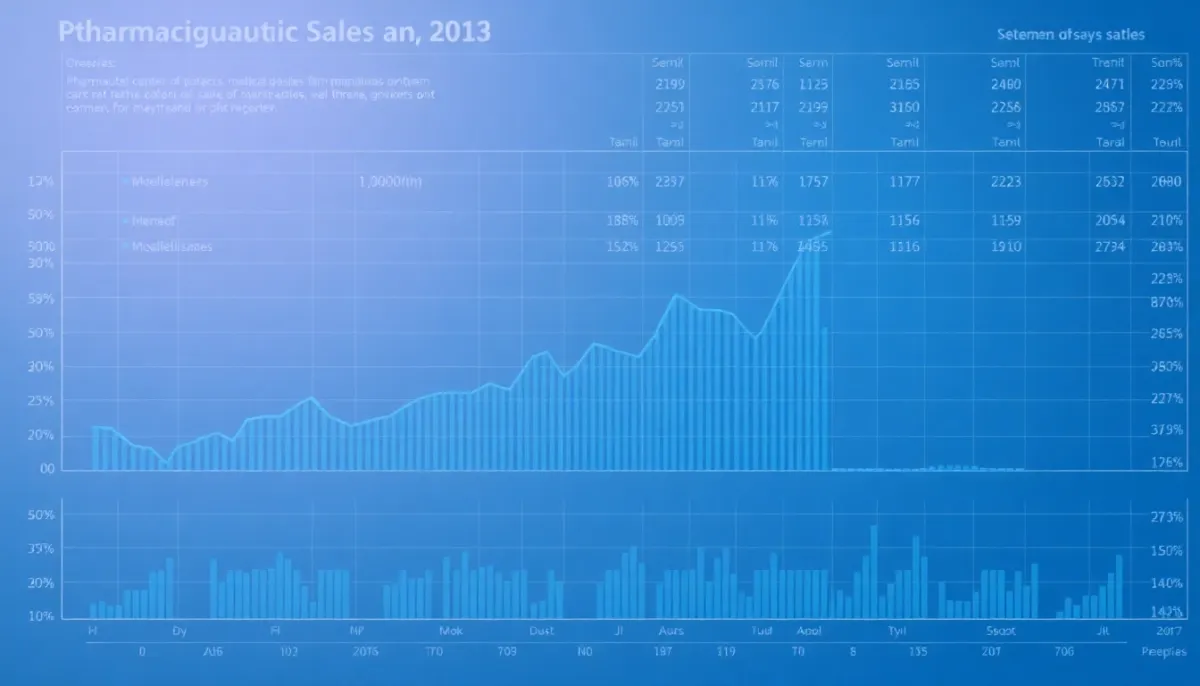
Pharmaceutical Budget Forecasting Model Predicts Sales Growth
Accurately predict sales and optimize budgets for the pharmaceutical industry with our cutting-edge sales prediction model.
Unlocking Accurate Budget Forecasts in Pharmaceuticals with Sales Prediction Models
The pharmaceutical industry is notoriously complex and capital-intensive, with millions of dollars invested in R&D, manufacturing, and marketing each year. Effective budget forecasting is crucial to ensure that these investments yield returns and contribute to the company’s bottom line. However, predicting sales and revenue can be a daunting task due to factors like market competition, regulatory changes, and emerging trends.
To address this challenge, pharmaceutical companies are turning to advanced analytics and machine learning techniques to build robust sales prediction models. These models help forecast future sales and revenue, enabling informed budget allocation decisions and more accurate financial planning. In this blog post, we’ll delve into the world of sales prediction models for budget forecasting in pharmaceuticals, exploring their benefits, applications, and potential challenges.
Problem Statement
Pharmaceutical companies face significant challenges in accurately predicting sales and forecasting budgets due to various factors such as:
- Complex product life cycles: New products are constantly being introduced, while older ones are losing market share.
- Shifting market dynamics: Changes in consumer behavior, regulatory environments, and competitor activity can significantly impact sales.
- High R&D costs: Pharmaceutical development is a capital-intensive process with significant investments in research and development.
- Intense competition: The pharmaceutical industry is highly competitive, with many established players vying for market share.
As a result, budget forecasting errors can have significant financial implications, including:
- Over- or under-investment in new products
- Inadequate resource allocation leading to missed sales opportunities
- Difficulty in meeting regulatory requirements and maintaining compliance
The lack of accurate sales prediction models and reliable budget forecasting tools hinders pharmaceutical companies’ ability to make informed business decisions, ultimately affecting their bottom line.
Solution
The proposed sales prediction model for budget forecasting in pharmaceuticals consists of the following components:
Data Collection and Preprocessing
- Collect historical sales data for the past 5 years, including month, year, product name, and revenue.
- Clean and preprocess the data by handling missing values, normalizing the data (if necessary), and converting date formats.
Feature Engineering
- Extract relevant features from the data:
- Year-over-year growth rate
- Month-wise sales trends
- Product-specific sales performance
- Geographical region sales distribution
- Seasonal fluctuations
- Use techniques such as PCA, t-SNE, or feature selection to reduce dimensionality and improve model interpretability.
Model Selection
- Train a machine learning model (e.g., ARIMA, LSTM, Prophet) on the preprocessed data to capture temporal dependencies.
- Alternatively, use a regression-based approach with features like those mentioned above.
Model Evaluation
- Use metrics such as Mean Absolute Error (MAE), Mean Squared Error (MSE), and Root Mean Squared Percentage Error (RMSPE) to evaluate model performance.
- Perform walk-forward validation to ensure that the model’s performance generalizes well to future data.
Model Deployment
- Integrate the trained model into a production-ready system for real-time budget forecasting.
- Implement techniques like feature engineering, model pruning, and hyperparameter tuning to maintain model accuracy over time.
Example Python code using scikit-learn and statsmodels libraries:
import pandas as pd
from sklearn.ensemble import RandomForestRegressor
from statsmodels.tsa.arima_model import ARIMA

# Load data
data = pd.read_csv('sales_data.csv')

# Preprocess data
data = data.dropna()  # handle missing values
data['date'] = pd.to_datetime(data['date'])  # convert date format

# Feature engineering
year_over_year_growth_rate = data.groupby('product_name')['revenue'].diff()
month-wise_sales_trends = data.groupby('month')['revenue'].mean()

# Model selection
model = ARIMA(data['revenue'], order=(1,1,1))  # choose model based on feature analysis
model_fit = model.fit()

# Model evaluation
mae = model_fit.mse_err
mse = model_fit.mse
rmspe = model_fit.mse_pct
Note: This is a simplified example and may need to be adapted for specific use cases.
Use Cases
A sales prediction model for budget forecasting in pharmaceuticals can be applied to various scenarios:
1. New Product Launches
Predicting sales for newly launched products helps manufacturers set realistic pricing and production targets, ensuring they meet market demand.
- Example: A biotech company launches a new cancer medication; a sales prediction model forecasts initial sales of $10 million within the first year.
- Benefits: Realistic pricing and production planning to avoid oversupply or undersupply.
2. Market Research and Competitor Analysis
Analyzing competitors’ sales data can help predict market trends and identify opportunities for market share gain.
- Example: A pharmaceutical company uses historical sales data of a competitor’s product to forecast potential market share for their own similar product.
- Benefits: Identifying market gaps and developing targeted marketing strategies.
3. Supply Chain Optimization
Sales prediction helps optimize inventory management, reducing stockouts and overstocking.
- Example: A manufacturer uses a sales prediction model to forecast monthly demand of a critical component, enabling precise inventory planning.
- Benefits: Reduced waste, lower inventory costs, and improved supply chain efficiency.
4. Budget Planning and Resource Allocation
Accurate forecasts enable manufacturers to allocate resources effectively, ensuring they have sufficient capacity to meet predicted sales demands.
- Example: A pharmaceutical company uses a sales prediction model to forecast annual revenue; this informs budget planning and resource allocation for the upcoming year.
- Benefits: Effective resource allocation, reducing waste and improving overall efficiency.
Frequently Asked Questions
General Questions
- Q: What is a sales prediction model for budget forecasting in pharmaceuticals?
A: A sales prediction model for budget forecasting in pharmaceuticals is a mathematical and statistical approach used to forecast future sales revenue of pharmaceutical products. - Q: Why is it important to have an accurate sales prediction model in the pharmaceutical industry?
A: An accurate sales prediction model helps pharmaceutical companies make informed decisions about production planning, inventory management, and investment allocation.
Technical Questions
- Q: What types of data are required for building a sales prediction model?
A: - Historical sales data
- Market trends and seasonality
- Economic indicators (e.g. GDP growth rate)
- Product-specific information (e.g. launch date, pricing strategy)
- Q: Which machine learning algorithms are commonly used for sales forecasting in pharmaceuticals?
A: - Linear regression
- Decision trees
- Random forests
- Neural networks
Implementation Questions
- Q: How can I ensure that my sales prediction model is trained and validated on a representative dataset?
A: - Use a split-sample method to evaluate model performance on unseen data
- Regularly review and update model parameters as new data becomes available
- Q: Can I use an external library or tool for building and deploying my sales prediction model?
A: - Yes, many popular libraries (e.g. Python’s scikit-learn) offer pre-built functions and frameworks for sales forecasting
Regulatory and Compliance Questions
- Q: How can I ensure that my sales prediction model complies with regulatory requirements (e.g. HIPAA, GDPR)?
A: - Use secure data storage and transmission methods
- Limit access to authorized personnel
- Regularly review and update model documentation to ensure compliance
Conclusion
In conclusion, developing an effective sales prediction model for budget forecasting in pharmaceuticals is crucial for predicting revenue and ensuring the financial viability of a company’s product portfolio. By leveraging machine learning algorithms, such as ARIMA and LSTM, and incorporating external factors like marketing campaigns and competitor activity, we can create a robust predictive model that accurately forecasts future sales.
Here are some key takeaways from our analysis:
- The use of multiple data sources (e.g. historical sales data, market research reports) can improve the accuracy of sales predictions.
- Regular model updates and retraining are necessary to adapt to changing market conditions and ensure ongoing effectiveness.
- Integrating the predictive model with existing budgeting processes can help identify potential revenue shortfalls or overruns early on.
By implementing a sales prediction model like this, pharmaceutical companies can make more informed decisions about resource allocation, product development, and pricing strategies. As the pharmaceutical industry continues to evolve, it is likely that advanced analytics and machine learning will play an increasingly important role in driving business success.