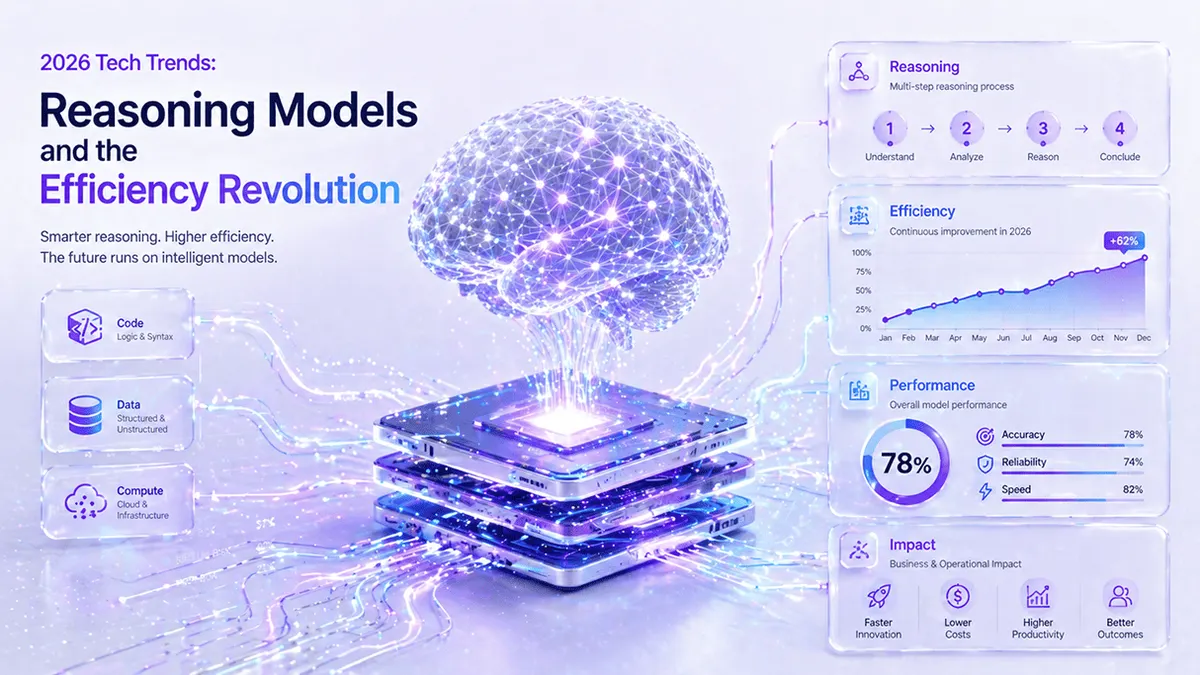
AI that doesn’t just predict — it thinks, plans, and solves.
What Are Reasoning Models — And How Are They Different?
Reasoning models represent a shift from traditional AI systems that rely on pattern recognition to systems capable of structured thinking.
Instead of producing quick answers based on learned patterns, these models build step-by-step chains of reasoning to arrive at more accurate and context-aware outcomes.
This enables a new level of capability.
They can break down complex problems into manageable steps, operate effectively even with incomplete or ambiguous data, and provide explanations for their decisions — making them far more transparent and reliable.
For example, instead of simply classifying a request, a reasoning system can evaluate multiple conditions and recommend the optimal processing path based on business rules, constraints, and priorities.
Where Reasoning AI Creates Immediate Value
Logistics Optimization
Reasoning models can handle multi-variable route planning, taking into account traffic conditions, weather, delivery priorities, and operational constraints — all at once.
Financial Modeling
They enable advanced scenario analysis, stress testing, and strategic recommendations, helping organizations make more informed financial decisions under uncertainty.
Legal Compliance
Reasoning AI can analyze contracts and policies across different jurisdictions, identifying risks and ensuring alignment with regulatory requirements.
R&D Acceleration
From generating hypotheses to validating them, reasoning systems shorten experimentation cycles and help teams move from idea to insight faster.
Our Approach to Implementing Reasoning Systems
Problem Scoping
Not every task requires reasoning AI. We identify high-impact use cases where multi-step decision-making delivers measurable ROI.
Hybrid Architecture
We combine large language models, rule-based systems, and specialized algorithms to create robust and efficient solutions tailored to your needs.
Explainability by Design
Every decision comes with a clear “why.” This ensures trust, supports audits, and enables your team to confidently rely on AI-driven outcomes.
Iterative Deployment
We start with controlled environments — sandbox testing, followed by pilot programs — and scale gradually with continuous monitoring of reasoning quality and performance.
Measuring Success: KPIs for Reasoning AI
Faster Decision-Making
Reduce time required for complex decisions by 40–70%, freeing up valuable expert resources.
Fewer Errors
Minimize mistakes in multi-step processes by introducing structured, logic-driven workflows.
Improved Customer Satisfaction
Deliver more accurate, context-aware recommendations that directly impact user experience.
Operational Cost Savings
Automate high-level analytical and decision-making tasks, reducing reliance on manual expertise.
Bonus: Reasoning models can be trained on your internal best practices — turning your organizational knowledge into a scalable asset.
Frequently Asked Questions
How are reasoning models different from the AI tools we already use?
Most traditional AI tools focus on prediction or classification. Reasoning models go further by breaking down problems, evaluating multiple steps, and generating structured solutions rather than single outputs.
Do reasoning models require more data or computing power?
They can be more resource-intensive depending on the use case. However, with the right architecture and optimization, it’s possible to balance performance with cost efficiency.
How long does it take to implement a reasoning solution?
It depends on complexity, but many organizations can launch an initial pilot within weeks. Full-scale deployment typically follows an iterative approach.
Can reasoning models work with our existing data and systems?
Yes. Most implementations are designed to integrate with your current infrastructure, leveraging existing data sources while enhancing decision-making capabilities.