
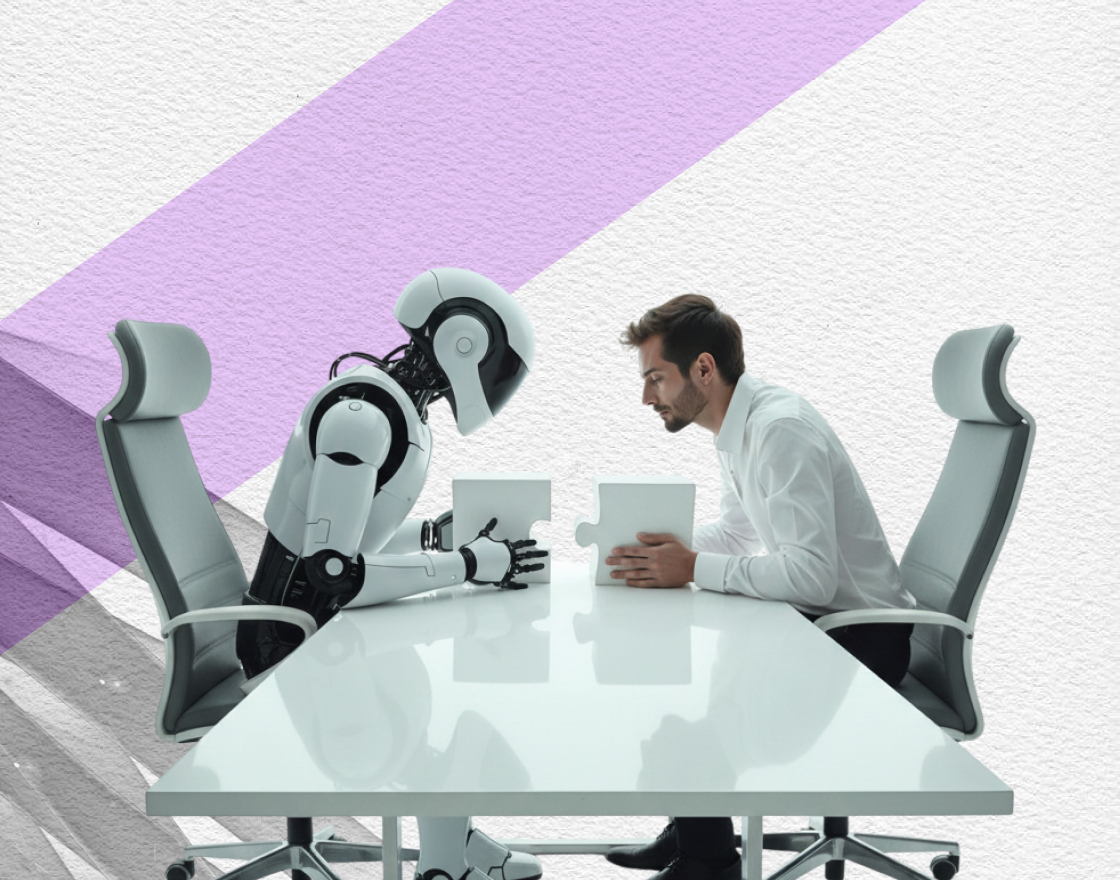
AI Is Moving Deeper into the Economy, Business, and Public Governance
AI Is Moving Deeper into the Economy, Business, and Public Governance
What the data confirms — and what companies should do next
AI is no longer a niche experiment for a few innovation teams. Evidence from international institutions and large research bodies shows it is becoming a systemic factor: influencing labor markets, cost structures, decision speed, and the quality of public services. The biggest shift is not that AI can generate content — it’s that AI is increasingly being embedded into workflows and connected to real operational systems, so it supports execution, not just ideas.
AI’s economic footprint is now macro-scale
One of the clearest signals of AI’s depth is labor-market exposure. The IMF estimates that around 40% of global employment is exposed to AI, and that exposure rises to about 60% in advanced economies. Importantly, exposure splits in two directions: many tasks may be complemented (raising productivity), while others may be substituted (reducing labor demand in certain roles) (IMF, 2024).
The value potential is also measured in macro terms. McKinsey estimates that generative AI could add the equivalent of $2.6–$4.4 trillion annually across the use cases it analyzed (McKinsey, 2023). When potential is counted in trillions, AI stops being a “tool choice” and becomes a competitiveness issue.
In business, the focus is shifting from “assistant” to “operating system”
Many organizations first adopt AI through copilots, faster content production, or basic customer-support automation. These can deliver quick wins, but they rarely change the core economics of a company. Deeper impact appears when AI is connected to workflows and systems — pulling from CRM, ticketing, finance, operations, and analytics — and helping move work forward through routing, status updates, anomaly flags, and structured reporting.
This direction is reflected in employer expectations. The World Economic Forum reports that surveyed companies expect 42% of business tasks to be automated by 2027, with the highest automation potential in information and data processing (WEF, 2023).
Investment trends reinforce the “second wave” of adoption — scaling, not isolated pilots. Stanford’s AI Index reports that funding for generative AI nearly octupled from 2022 to reach $25.2B (Stanford HAI, 2024).
In practice, AI goes “deeper” in a company when it is connected to:
• Data: CRM, finance, inventory, support, analytics
• Rules: policies, SLA logic, quality checks
• Actions: task creation, routing, approvals, status updates, alerts, reporting
Public governance is moving from pilots to service delivery
AI adoption is also increasingly visible in government operations and citizen-facing services. OECD reporting notes that 67% of OECD countries are using AI to improve the design and delivery of public services (OECD, 2025). This is significant because public services require accountability, stable procedures, and strong data safeguards — conditions that push AI from experimentation toward institutional use.
Adoption is rising quickly, but maturity is uneven
To avoid the false impression that “everyone has already implemented AI,” it helps to look at adoption data. Eurostat reports that among EU enterprises with 10+ employees, AI use rose from 13.5% in 2024 to 20.0% in 2025 (Eurostat, 2025). This growth is substantial, but it also confirms that many organizations are still early — which creates a widening gap between companies that build strong foundations and those that rely on ad-hoc tools.
What companies should do next
The most reliable approach is to treat AI as an operational capability — not a collection of disconnected tools. Start with workflows where outcomes are measurable and visible quickly, then connect AI to systems where work is executed, and build the guardrails that make scale possible.
A practical implementation model:
• Start with measurable workflows. Choose one process where impact can be tracked in weeks: time-to-response, time-to-resolution, error/rework rate, SLA breaches, operational delays, conversion leakage.
• Connect AI to systems of record and systems of action. Value rises when AI can read from real data and help trigger steps forward: routing, task creation, structured summaries, status updates, and alerts.
• Build guardrails early. Use role-based access, audit logs, approvals for high-risk actions, and monitoring for quality drift — especially for customer-facing or regulated workflows.
AI is moving deeper because execution matters more than ever. Organizations that embed AI into how work actually runs — supported by clean data, integrated systems, and clear controls — will gain speed, reliability, and cost advantages as adoption accelerates.
How ReNewator helps companies operationalize AI
ReNewator helps companies move from isolated AI experiments to a controlled operating model where AI delivers measurable outcomes: faster decisions, fewer errors, clearer process visibility, and lower operational friction.
We start with process and data diagnostics, identify high-ROI workflows, connect the required integrations, and build end-to-end chains from signal → decision → action — with access controls, audit logs, and quality guardrails.